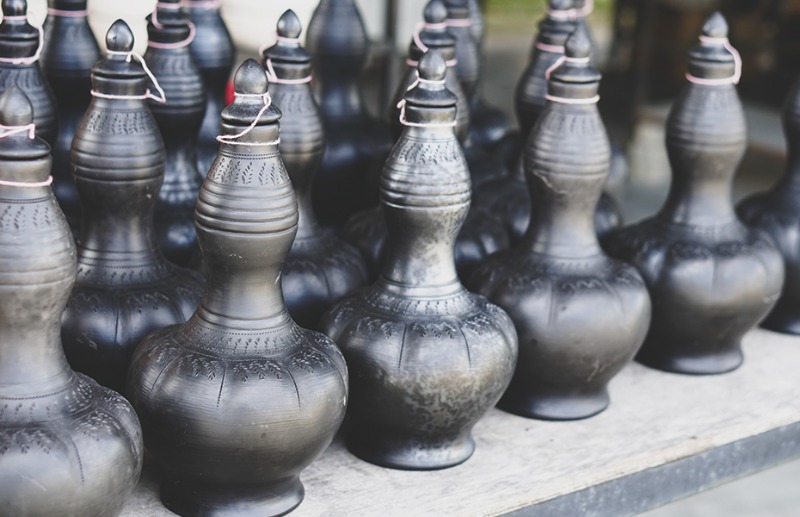
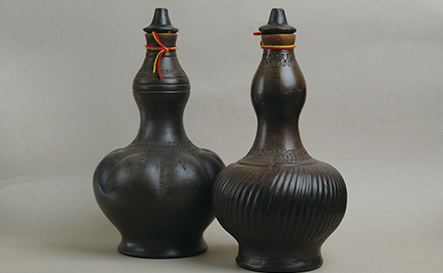
A traditional jar used in Malaysia, the Labu Sayong is a popular handicraft. Kuala Kangsar of the Perak state has long captured the essence of Labu Sayong, which is made with a special clay found in Perak. Most Labu Sayong are shaped like a gourd.
The shape of the Labu Sayong originates from the fact that Malay people used to use gourds or pumpkins to store water. Water stored in Labu Sayong are kept cooler and are also used to treat coughing and fevers. Currently, around one million people still know how to make a Labu Sayong.
The special clay used to make Labu Sayong are collected from a river bank. The clay is dried under the sun, ground into a fine powder, and sifted. This clay powder is mixed with water to make a paste. Today, salt is sometimes added to the paste. Labu Sayong are created on a spinning wheel and molded into their unique shape. Depending on the weather, finished Labu Sayong will dry in one to three days. Labu Sayong are dried in three stages. Firstly, the jars are baked in a kiln at 1,200 degrees Celsius for 10 hours. They are then covered in rice brans and heated in rattan, coconut, and bamboo until they become ruddy in color. After they are cooled, the Labu Sayong are ready to be used.
Labu Sayong have a glossy surface and come in a variety of different colors, from yellowish brown and black to rusty red, depending on the level of iron in the clay. Most commonly, Labu Sayong have dark color, and are decorated with nature-themed symbols, such as leaves and flowers.




 KOREA FOUNDATION